
 ch
 Italy
 France
 Spain
 Portugal
 Poland
 Bulgaria
 Czech republic
 Slovakia
 Romania
 Turkey
 Lithuania
 Germany
 Montenegro
 Netherlands
 Serbia
 United Kingdom
 Croatia
 Hungary
 Luxembourg
 Ireland
 Norway
 Denmark
 Brazil
 Argentina
 Colombia
 India
 China
 Hong Kong (China)
Workforce adaptability now determines how quickly a company can respond to changes such skills shortages, AI and fluctuating demand. Swiss companies are well positioned when it comes to flexible workforce models. However, the data reveals gaps in building new skills and in long-term planning.
This article is based on the international study “Built to Adapt: Designing Workforce Systems for Continuous Change” by Gi Group Holding and Financial Times Longitude. In April and May 2026, 750 senior executives from 15 countries and seven industries were surveyed, including 30 decision-makers in Switzerland.
In this article, we show where Swiss companies stand in international comparison and what the most successful organisations do differently.
Key Takeaways
- According to the Gi Group Holding study “Built to Adapt” (2026), half of the Swiss executives surveyed rate their organisation as highly adaptable in its use of different workforce models, compared with 30% globally.
- 67% of Swiss companies have increased their use of temporary and contract workers over the past three years, and 70% plan to expand it further over the next three years.
- For 67% of Swiss respondents, upskilling and reskilling at scale is the biggest obstacle to executing their workforce strategy.
- 60% of Swiss companies prioritise short-term performance targets over long-term capability building, compared with a global average of 45%.
- Only 10% of companies worldwide meet the criteria of the “Workforce Adaptability Leaders”, and this group outperforms all others on every business metric studied.
Read the full report: all global findings, interviews with HR leaders from GEODIS, Unipart, British American Tobacco and other companies, and the Workforce Adaptability Operating Model are available in the report.
Why has workforce adaptability become a competitive advantage?
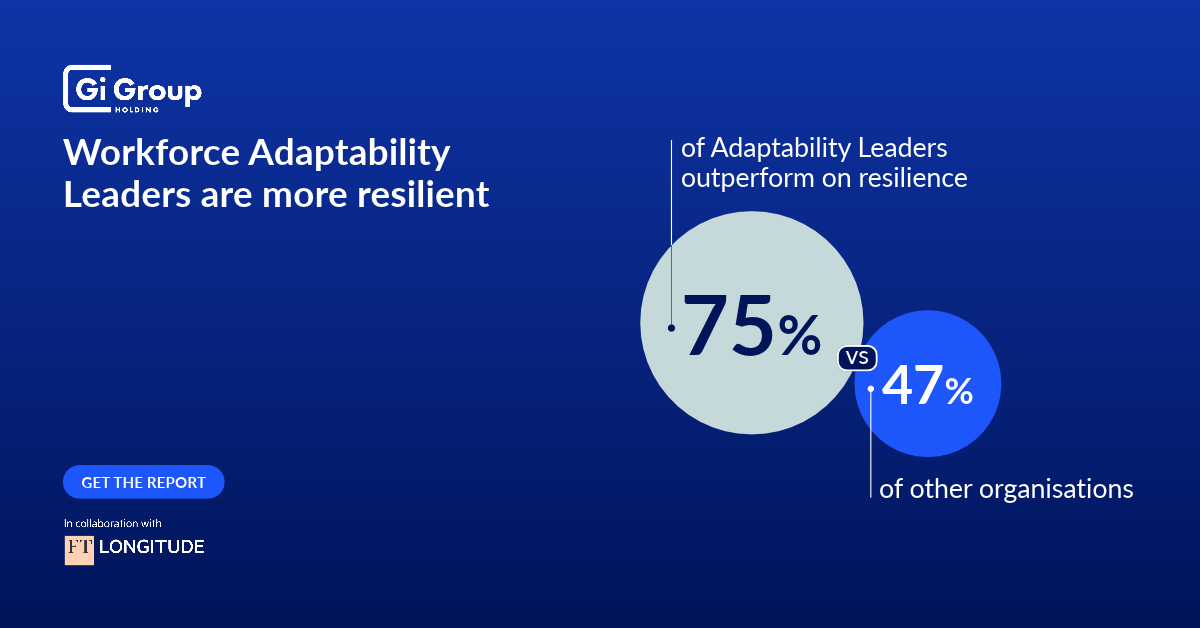
Companies with a highly adaptable workforce outperform the rest on every business metric. This is shown by the group of “Workforce Adaptability Leaders”: the 10% of companies surveyed worldwide that combine flexible workforce models with fast workforce decisions.
These leaders are found in all seven industries studied. In the Swiss sample, four out of 30 companies meet the criteria.
| Metric above expectations (past 12 months) | Workforce Adaptability Leaders | Everyone else |
| Customer satisfaction | 77% | 49% |
| Revenue performance | 75% | 52% |
| Organisational resilience | 75% | 47% |
| Employee productivity | 74% | 52% |
| Ability to attract and hire talent | 71% | 44% |
| Employee satisfaction | 70% | 48% |
Source: Gi Group Holding, “Built to Adapt”, global survey of 750 senior executives, April–May 2026.
The difference is not that leaders use more freelancers or invest more in AI. They have built systems that continuously align recruitment, upskilling, internal mobility, external partners and automation.
How adaptable are Swiss companies by comparison?
Swiss companies are significantly more flexible than the global average in their use of different workforce models. When it comes to redeploying employees internally, however, they lag behind.
| Area: “highly adaptable” | Switzerland | Global |
| Use of different workforce models (permanent, temporary, outsourced) | 50% | 30% |
| Workforce management systems (skills mapping, planning, learning platforms) | 37% | 27% |
| Attracting and retaining the right talent | 27% | 25% |
| Making and implementing workforce decisions quickly | 27% | 27% |
| Redeploying employees into different roles or projects | 23% | 31% |
Source: Gi Group Holding, “Built to Adapt”, April–May 2026; Switzerland n = 30, global n = 750.
The strength in workforce models reflects the Swiss labour market, where temporary work and project assignments are well established. The weakness in internal mobility matters because knowledge and skills often remain tied to individual people.
Flexible workforce models: Switzerland relies more on temporary staffing
Swiss companies are expanding flexible workforce models more than companies in other countries. Temporary and contract workers and the redesign of roles in particular are gaining ground, while permanent headcount is stagnating.
| Workforce lever | Increased over the past 3 years (CH / global) | Expected increase over the next 3 years (CH / global) |
| Temporary and contract workers | 67% / 53% | 70% / 54% |
| Redesign of roles and job structures | 67% / 55% | 67% / 54% |
| Automation of tasks and processes | 47% / 59% | 67% / 65% |
| Internal mobility and redeployment | 63% / 57% | 53% / 59% |
| Project-based and freelance talent | 57% / 62% | 50% / 60% |
| Outsourcing to third-party providers | 50% / 51% | 50% / 52% |
| Permanent employees | 20% / 38% | 30% / 37% |
Source: Gi Group Holding, “Built to Adapt”, April–May 2026; Switzerland n = 30.
Only 20% of Swiss companies have increased their permanent headcount over the past three years, while 30% have reduced it. This does not mean permanent employment is losing importance: it remains the core around which companies build flexible capacity.
In Switzerland, Gi Group operates in temporary staffing and permanent placement with the brands Gi Group, Grafton, BauTech and Gi Life Sciences. This combination allows companies to plan permanent and flexible capacity with a single partner.
Where is the biggest hurdle? Upskilling at scale
The greatest difficulty for Swiss companies is upskilling and reskilling large numbers of employees. 67% name upskilling and reskilling at scale as a key hurdle, compared with 57% globally.
At the same time, 37% of Swiss respondents consider upskilling the most important capability for responding to changing business needs (global: 27%). The awareness is there, but execution is lagging behind.
The pressure is coming from several directions. Swiss companies most often name the following drivers of change in their workforce structure:
- Technology and automation adoption (53%, global 46%)
- Cost and efficiency pressure (47%, global 47%)
- Skills shortages (47%, global 43%)
- The retirement wave of the baby boomer generation (30%, global 24%)
Official labour market data confirms the picture: in the first quarter of 2026, 34.3% of Swiss companies reported difficulties in recruiting staff, according to the Federal Statistical Office (Swiss Confederation SME Portal, 17.06.2026). The skills shortage has eased slightly, but it is still felt by one in three companies.
How is AI changing work in Swiss companies?
Swiss companies are progressing faster than the global average in implementing AI. 70% consider themselves on track or even ahead, compared with 58% globally.
67% have increased their use of AI and automation over the past 24 months to improve productivity (global: 53%). 63% name the reduction of manual and repetitive tasks as the most important impact.
A second effect stands out: 53% of Swiss respondents say AI is increasing productivity expectations of employees (global: 37%). By contrast, only 20% see headcount reduction as a main impact.
Implementation remains challenging. For half of Swiss companies, implementing AI effectively is one of the biggest challenges in their workforce strategy (global: 41%). Technology only pays off when workflows are redesigned and employees are equipped in a targeted way.
Short-term targets or long-term capability building?
Switzerland’s biggest gap lies in its time horizon. 60% of Swiss companies prioritise short-term performance targets over long-term capability building, compared with 45% globally.
Yet the foundations are in place. 70% explicitly link workforce performance to business strategy (global: 62%), and 73% manage it consistently across all teams.
The weaknesses lie in measurement and accountability:
- Only 53% have clear metrics for measuring workforce productivity (global: 60%).
- 43% base workforce decisions on judgement rather than data.
- Only 47% measure and reward leaders on workforce performance outcomes.
Employee wellbeing is also falling short. Only 33% of Swiss companies have launched new wellbeing initiatives in the past two years, compared with 60% of the global leaders.
More insights in the report: find out how GEODIS, Wabtec and Bodycote combine data, leadership and upskilling in the full “Built to Adapt” report
Four steps to an adaptable workforce
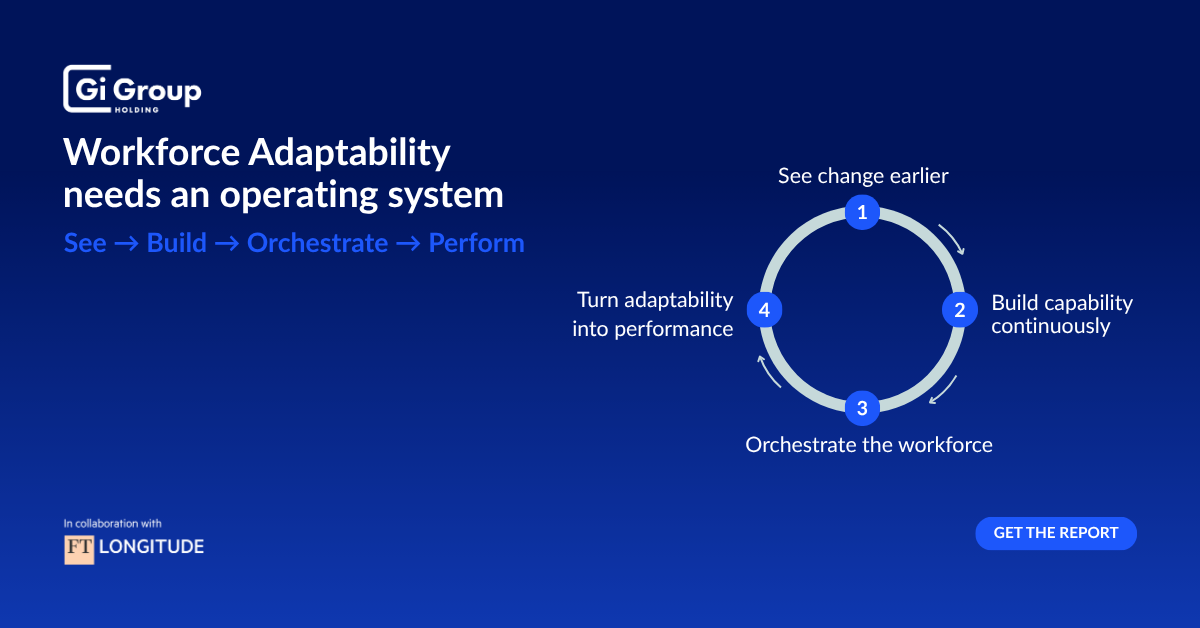
The study summarises the approach of the most successful companies in the “Workforce Adaptability Operating Model”. It consists of four connected capabilities.
| Step | Goal | Concrete actions |
| 1. See change earlier | Connect workforce planning to future demand and technology | Forecast future skills, align workforce planning with strategy |
| 2. Build capability continuously | Combine hiring, upskilling and knowledge transfer | Hire for future capability, enable internal mobility, capture the knowledge of long-serving employees |
| 3. Orchestrate the workforce | Balance permanent, flexible and external capacity as well as AI | Define the right workforce mix, use external talent where it adds value, make fast data-driven decisions |
| 4. Turn adaptability into performance | Strengthen leadership, culture and accountability | Hold leaders accountable for workforce outcomes, communicate transparently, invest in employability |
Quelle: Gi Group Holding, «Built to Adapt», 2026.
Two priorities follow for Swiss companies. First, upskilling needs dedicated structures and budgets rather than being treated as a side task. Second, the strength in flexible workforce models should be combined with a better data foundation and longer-term planning.
Gi Group is part of Gi Group Holding, a global ecosystem of HR services and consulting operating in 37 countries. This international perspective forms the basis for studies such as “Built to Adapt”.
Conclusion: the flexibility is there, now it is time to build skills
Workforce adaptability is a genuine strength in Switzerland when it comes to flexible workforce models and the use of AI. In upskilling, data and long-term planning, however, many companies still trail the Workforce Adaptability Leaders.
Closing this gap combines short-term flexibility with sustainable performance. The report shows how leading companies are putting this into practice.
Frequently asked questions about workforce adaptability
Workforce adaptability is a company’s ability to quickly adjust its headcount, skills and work organisation to changing requirements. It includes flexible workforce models, internal mobility, continuous learning and data-driven workforce decisions.
Upskilling extends employees’ skills for their current role. Reskilling prepares them for a new role or a different area of work, for example when tasks disappear due to automation.
Temporary staffing makes most sense for seasonal peaks, fixed-term projects or vacancies that need to be filled quickly. Many companies also use it to get to know candidates in day-to-day work before offering a permanent contract.
Yes, commercial staff leasing in Switzerland requires a licence and is regulated by the Federal Act on Recruitment and the Hiring of Services (AVG). Client companies should therefore only work with staffing providers that hold a valid licence.
Adaptability can be measured using metrics such as time to fill vacancies, the share of internal hires and the training participation rate. How quickly a company makes and implements workforce decisions is also a telling indicator.
Methodology: in April and May 2026, Gi Group Holding surveyed 750 senior executives (C-level, C-1 and C-2) at multinational companies in 15 countries and seven industries. The Swiss sample comprises 30 respondents.